Charging Your EV in Malaysia: What Changes Between a Landed House and a Condo

A landed house owner can usually get a wallbox installed within days by notifying TNB through a licensed Wireman - no third party sign-off required. A condo owner needs written JMB or MC consent before any work starts, and the metering setup decides whether the TNB off-peak tariff actually helps. Same car, same charger, different process and slightly different monthly bill.

The 60-Second Answer: Landed vs Condo EV Charging
Property type | Approval needed | Typical setup | Timeline |
Landed house (own supply) | TNB load notification via licensed Wireman; no outside consent | 7.4kW-22kW wallbox on own meter, single or three-phase | Days to about 1-2 weeks |
Condo - private bay, own supply | Written JMB/MC consent | 7.4kW single-phase wallbox + Type B RCD | 2-4 weeks |
Condo - communal/shared bay | JMB/MC resolution + TNB sub-meter application, possible ST notification | Multi-port system off shared MDB | 4-8+ weeks |
What Buyers Actually Mean by This Question
Most people typing this phrase have an EV on order or already in the driveway and have just realised their parking situation isn't simple. Landed owners usually want to know if they can just 'plug in and go'. Condo owners want to know whether their JMB can say no, and whether charging will cost more if it runs through a shared meter.
The honest answer is that the car doesn't change - the electricity supply chain behind the charger does. On your own TNB account, you control the tariff and the schedule. On a shared or communal supply, someone else's metering and billing policy sits between you and the socket.
Setup and Approval: What Actually Differs
In a landed home, the wallbox taps directly into your own distribution board and your own TNB meter. A licensed Wireman sizes the circuit, notifies TNB if the load requires it, and the installation is yours to control end to end. Full details are in our landed home installation guide.
In a condo, getting an EV charger approved comes down to three things: written consent from your JMB or MC, a metering decision between a private sub-meter and a shared bay, and a licensed Wireman handling the wiring. For a private bay running off your own unit's supply, most JMBs treat this as a written-consent matter rather than a full common-property resolution.
A communal or shared-bay setup is a different animal. It needs a JMB resolution, a TNB sub-meter application, and because it serves more than one owner, Suruhanjaya Tenaga's EVCS guideline GP/ST/No.54/2025 requires Type B RCD protection and a licensed Wireman on every installation regardless of which path you take. Our condo and JMB page walks through both routes.
The Real Running Cost: Where You Live and the ToU Tariff
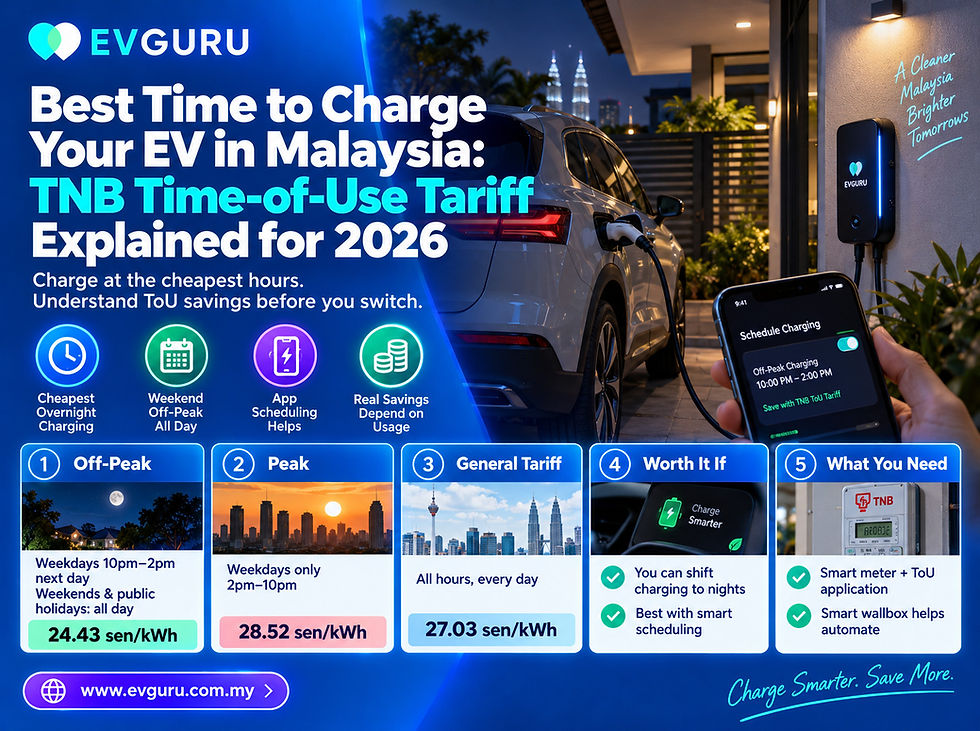
Since 1 July 2025, TNB has offered an optional Time-of-Use (ToU) tariff to domestic customers with smart meters, which charges less for usage shifted to off-peak hours - ideal for overnight EV charging. Whether you can actually use it depends on whose meter your charger sits behind.
Period | Hours | Rate (up to 1,500 kWh/month) |
Off-peak | 10pm-2pm weekdays, all day weekends & public holidays | 24.43 sen/kWh |
Peak | 2pm-10pm, weekdays only | 28.52 sen/kWh |
On a landed home or a condo private bay with its own TNB account, you can opt into ToU and shift charging to the cheap window yourself. On a communal condo bay billed through a shared JMB meter, the ToU rate generally isn't available bay-by-bay, since the scheme is opted in at the account level and the account belongs to the JMB, not the individual owner.
Setup | Tariff used | Monthly cost (300 kWh assumption) |
Landed house, Normal tariff | 27.03 sen/kWh + capacity & network charges (~44.43 sen/kWh effective) | ~RM133 |
Landed house, ToU off-peak only | 24.43 sen/kWh + capacity & network charges (~41.83 sen/kWh effective) | ~RM125 |
Condo private bay, own meter on ToU | Same as landed ToU off-peak | ~RM125 |
Condo communal bay, JMB-billed | Set by JMB's own tariff plan, rarely ToU-optimised | Varies by building |
These figures assume a 7kW home charger used to add roughly 300 kWh per month, based on TNB's post-July-2025 domestic tariff structure including capacity and network charges, as compiled in a Malaysian TNB bill breakdown guide. Your actual bill depends on how much you drive and how disciplined you are about charging off-peak.
The one mistake to avoid: don't skip JMB consent by quietly running an extension lead or a standard three-pin plug to your bay. Suruhanjaya Tenaga's EVCS guideline explicitly prohibits Mode 1 (standard socket) charging in these settings, and an undocumented installation can complicate insurance claims and get you a removal order later.
Homeowner vs JMB: Different Problems to Solve
If you own a landed house
Decide single-phase (7.4kW) or three-phase (up to 22kW) based on your car's onboard charger and your main switchboard capacity.
TNB load notification through your installer is usually the only formality.
You control the ToU opt-in and the charging schedule entirely yourself.
If you sit on a JMB committee or manage a condo
A resident cannot be refused a legitimate private-bay request without reasonable grounds - the Strata Management Act 2013 governs common-property works and gives owners a right to table proposals at a general meeting.
Defensible refusal grounds are narrow: no SIRIM-certified charger, no Type B RCD, or no licensed Wireman named in the proposal.
For a communal system serving multiple bays, GITA offers a 100% tax allowance on qualifying capex if your company or MC entity applies before the deadline - see our commercial EV charging page.
Incentive | Who it's for | Deadline |
Personal income tax relief, up to RM2,500 | Individual homeowners installing a charger at their own residence | Claimable for YA 2026 |
GITA (Green Investment Tax Allowance) | Companies/commercial entities, including MC-owned communal systems | Applications to MIDA by 31 Dec 2026 |
FAQ
Does a condo always cost more to charge an EV than a landed house?
Not necessarily. A condo private bay running on its own TNB sub-meter can opt into the same ToU off-peak tariff as a landed house and land on roughly the same bill. Cost only climbs when charging runs through a shared communal meter that isn't optimised for off-peak EV use.
Can my JMB refuse an EV charger installation outright?
Not without a defensible reason. The Strata Management Act 2013 governs common-property decisions, and a JMB generally cannot refuse a private, unit-supply installation that meets SIRIM certification, uses a licensed Wireman, and includes Type B RCD protection.
Is the TNB off-peak tariff worth it if I live in a condo?
Only if your bay has its own TNB account or sub-meter, since ToU is opted in at account level. If your condo bills EV charging through a shared JMB meter, ask your committee whether a sub-meter upgrade is being considered.
How much longer does condo approval take compared to a landed install?
A landed installation can often be scheduled within one to two weeks of ordering. A condo private bay typically needs two to four weeks for JMB consent, and a communal system can take four to eight weeks or longer due to the TNB sub-meter application and meeting cycles.
What happens if I install a charger in my condo without telling the JMB?
You risk a removal order, a complicated insurance claim if there's an electrical incident, and non-compliance with Suruhanjaya Tenaga's EVCS guideline, which mandates Type B RCD and licensed installation for every condo charger. Getting written consent first protects both you and the building.

Sources & Assumptions
TNB Time-of-Use (ToU) domestic tariff structure, effective 1 July 2025: off-peak 24.43 sen/kWh, peak 28.52 sen/kWh for usage up to 1,500 kWh/month.
Monthly cost estimates assume a 7kW home charger adding approximately 300 kWh/month, using TNB's post-July-2025 domestic tariff including capacity and network charges.
Suruhanjaya Tenaga EVCS guideline GP/ST/No.54/2025 governs Type B RCD, licensed Wireman requirements, and prohibits Mode 1 charging in condo/strata settings.
Strata Management Act 2013 (Act 757) governs JMB/MC authority over common property and resident proposal rights.
Personal income tax relief of up to RM2,500 is claimable for YA 2026; GITA applications for commercial EV charging capex close 31 December 2026 via MIDA.
Not sure which setup fits your property? Our team can review your switchboard, parking type, and (if applicable) your JMB's requirements, then recommend single-phase or three-phase accordingly - browse the Guru Swift Advance wallbox or get a site-specific quote today.