

At a glance
Timeline
Confirmed after site assessment
Funding
Purchase or site-specific partnership
Requirements
Reviewed for your site
Billing
App or RFID options
THE BASICS
How condo charging works
Who pays
The building can purchase the chargers or discuss a partnership. Funding and revenue-sharing options depend on site suitability and agreed commercial terms.
Who has access
The property decides, and sees revenue and power usage in the CMS.
How residents pay
Monthly subscription or per-use charges set by the property, via the EvGuru app or RFID card.
Power
Dynamic load management lets several chargers share the building's supply; a phased 7kW plus load-management path stays within existing headroom where possible.
Residences we've equipped
Explore examples of EvGuru charging installations at residential properties. We can discuss a relevant installation and the options for your building during a site assessment.
Rimbun @ Embassy Row
Shared condo EV charging, profit share.
Two shared EvGuru charging bays for residents.

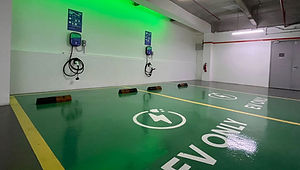
Four Seasons Residence, KLCC
Residential EV charging.
2 × 22kW chargers.
Surian Condo, Petaling Jaya
Condo EV charging.
2 × 22kW chargers.
Two ways residents charge
A charger at a resident's own bay, or shared chargers in common areas run by the JMB/MC.
Shared chargers for the building
Shared bays for residents or visitors, with access and billing agreed by management. EvGuru reviews site suitability and the approvals needed for the proposed operating model.
Private charger, own bay
A charger for a resident’s own bay starts with management consent and a site assessment. Electrical capacity, cable routing and applicable requirements are checked before installation.
What your building manager will ask for
Charger and load
Charger type and load; single-line diagram.
Building supply
Riser / transformer load study; cable route and trunking.
Billing and safety
Metering or billing method; RCD Type B protection.
Cover and credentials
Insurance and indemnity; ST-certified installer credentials.
Shared chargers: the steps
1. JMB decision
Committee resolution and an EV by-law. We provide a one-page board paper and a draft by-law.
2. Feasibility pack
Credentials, single-line diagram, load study, insurance, plus a free 15-minute committee briefing.
3. Site survey
Joint walk with the building’s M&E team: DB capacity, cable route, bay position.
4. Scope and billing
Charger count, load management, OCPP back-office and billing model, written into the consent.
5. Approvals and install
Confirm required approvals, install and test the chargers, then hand over the agreed operating arrangements.
Timing depends on the site survey, committee decisions, electrical works and required approvals. We confirm a programme in the proposal.
Committee questions
Does a private bay charger need approvals?
Requirements depend on the installation and intended use. Obtain management consent and have the electrical and approval requirements checked before work starts.
Will chargers overload the building's supply?
Load management lets chargers share the available power; the load study shows what's available before anything is installed.
How long does it take?
We confirm timing after assessing the site, scope and required approvals.
Do shared chargers need a licence?
Shared or publicly accessible charging can require additional approvals. EvGuru reviews the operating model and confirms the applicable process for your site.
Does the JMB have to pay upfront?
Purchase or partnership options depend on site suitability and agreed commercial terms.
What if our JMB says no?
Ask for the reasons in writing. A proposal can address available power, cable routing, metering and safety so the committee can assess the options.
Request a Commercial Site Assessment