

Best Time to Charge Your EV in Malaysia: TNB Time-of-Use Tariff Explained for 2026

The cheapest time to charge an EV in Malaysia under TNB's Time-of-Use (ToU) tariff is overnight on weekdays, from 10pm to 2pm the next day, or any time at all on Saturdays, Sundays and public holidays, when the off-peak rate of 24.43 sen/kWh applies. Charging during the weekday peak window of 2pm to 10pm costs 28.52 sen/kWh for most households - that is not a penalty, just 1.49 sen/kWh more than the flat general tariff. Whether switching to ToU is actually worth it depends on how much of your home charging you can genuinely shift into that off-peak window.
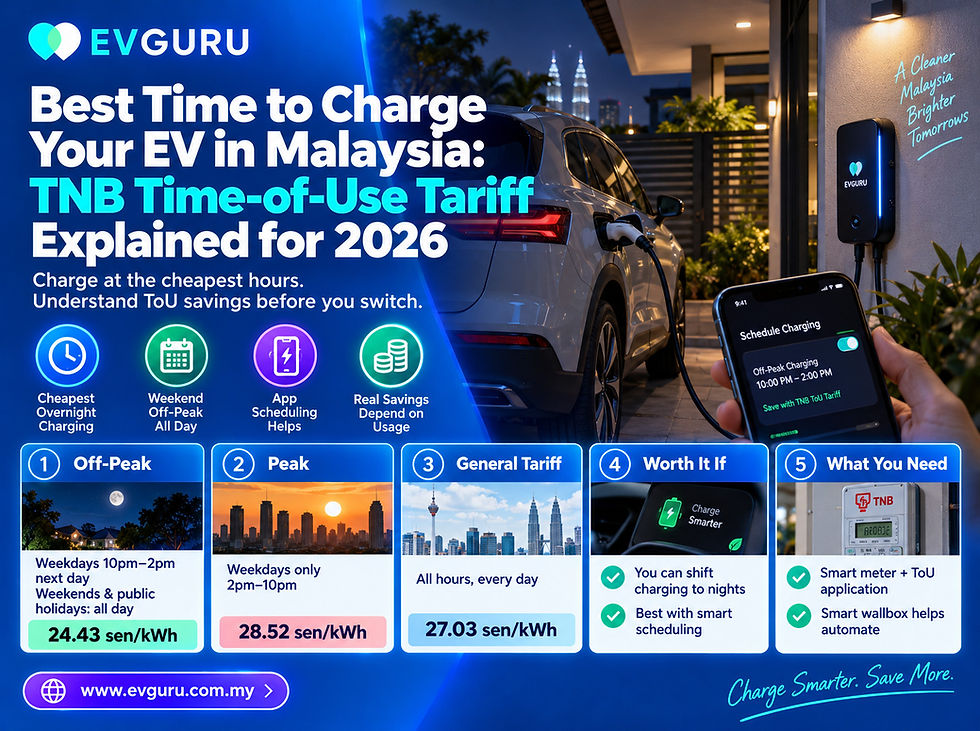
The 60-Second Answer: When TNB's ToU Tariff Rewards EV Charging
Off-peak (cheapest): weekdays 10pm to 2pm the next day, plus all 24 hours on Saturday, Sunday and public holidays - 24.43 sen/kWh for the first 1,500 kWh/month.
Peak (priciest): weekdays only, 2pm to 10pm - 28.52 sen/kWh for the first 1,500 kWh/month.
The spread: off-peak is 2.6 sen/kWh cheaper, peak is 1.49 sen/kWh pricier, than the flat 27.03 sen/kWh general tariff most households are already on.
ToU is opt-in, not automatic - you need a smart meter with CT or RMR capability to apply.
A smart wallbox with app scheduling does the time-shifting for you, so you do not need to physically plug in at 10pm.
What Malaysian EV Owners Actually Mean by 'Best Time to Charge'
Most people searching this phrase are really asking two different things: literally which hour is cheapest, and whether it is worth the paperwork to switch tariff plans at all. The hour question has one answer - night and weekends. The switching question depends on your household's usage pattern, which is why the worked example below uses real TNB rates rather than a generic estimate.
This guide covers home charging only. Public DC fast chargers from operators like Gentari, JomCharge and ChargEV run on their own posted per-kWh pricing and are not affected by your home ToU status.
TNB's ToU Peak and Off-Peak Windows and Rates (Effective 1 July 2025)
TNB rolled out the restructured domestic tariff, including the optional ToU scheme, from 1 July 2025. According to TNB, Time-of-Use is a scheme that lets customers manage their electricity usage more efficiently and enjoy lower rates during off-peak hours, and it remains opt-in for domestic customers with a compatible smart meter.
Period | Hours | Rate (up to 1,500 kWh/mo) | Rate (above 1,500 kWh/mo) |
Peak | Weekdays, 2:00pm-10:00pm | 28.52 sen/kWh | 38.52 sen/kWh |
Off-peak (weeknights) | Weekdays, 10:00pm-2:00pm next day | 24.43 sen/kWh | 34.43 sen/kWh |
Off-peak (weekend/holiday) | All 24 hours | 24.43 sen/kWh | 34.43 sen/kWh |
General tariff (no ToU) | All hours, every day | 27.03 sen/kWh | 37.03 sen/kWh |
On top of the energy rate, both peak and off-peak kWh carry the same 4.55 sen/kWh capacity charge and 12.85 sen/kWh network charge, plus a RM10/month retail charge that is waived if usage is 600 kWh or below. These additions apply equally whether you are on the general tariff or ToU, so they do not change the decision - only the energy charge does.
Worked Example: What ToU Actually Saves on an EV Charging Bill
Assume a landed home using 900 kWh a month in total, of which roughly 150 kWh is EV charging. If the household shifts most usage to off-peak hours - say 700 kWh off-peak (night charging plus weekends) and 200 kWh during weekday peak (afternoon aircon, evening cooking) - here is how the bill compares.
Tariff | Blended rate (energy+capacity+network) | Monthly cost (900 kWh) |
General tariff (flat) | 44.43 sen/kWh | RM409.87 (incl. RM10 retail charge) |
ToU - 700 kWh off-peak, 200 kWh peak | 41.83 sen/kWh off-peak, 45.92 sen/kWh peak | RM394.65 (incl. RM10 retail charge) |
Monthly saving | - | RM15.22 (~RM180/year) |
That RM15 a month is modest, not dramatic - the ToU spread is smaller than many EV owners expect. The saving scales with how much of your total household load, not just EV charging, you can genuinely move into the off-peak window.
The one mistake to avoid: switching to ToU and then still running the aircon, dryer, or EV charger out of habit during the 2pm-10pm window. Every peak kWh now costs 1.49 sen more than the general tariff with nothing to offset it, so an unchanged usage pattern can leave you slightly worse off than before you switched.
Is Switching to ToU Worth It for Your Home?
Likely worth it: you work during the day, charge the EV overnight, and can push laundry or water heating to night or weekends.
Likely worth it: your household already consumes most of its electricity between 10pm and 2pm the next day, or on weekends.
Probably not worth it: someone is home all day running the aircon through the 2pm-10pm window with little flexibility to shift it.
Neutral either way: very low overall consumption (under 600 kWh/month), where the retail charge is waived on both plans and the rate gap barely moves the needle.
Scheduling EV Charging From a Smart Wallbox
A smart wallbox removes the need to remember the clock. Set a charging schedule once in the app - start at 10pm, stop by 6am - and the charger holds off even if you plug in straight after work at 6pm, so every session lands inside the off-peak window automatically. The Guru Swift Advance supports this kind of app-based scheduling alongside its 7.4kW-22kW output range.
Installation still needs to go through a licensed Wireman with a Type B RCD per Suruhanjaya Tenaga guidelines, regardless of which charger or tariff you choose. For a full walkthrough of the process, see our landed-home installation guide or browse the full charger range.
Homeowners vs JMB/Commercial: Does ToU Timing Matter Differently?
Landed homeowners apply for ToU directly on their own domestic meter, and the savings flow straight to their personal TNB bill. Condo and apartment chargers are a different story - charging points usually sit on the building's shared meter under a commercial tariff, not the resident's personal domestic ToU account, which is why JMBs need to look at the commercial rate structure separately. Our condo and JMB page covers how shared-meter billing typically works for EV bays.
Customer type | Peak rate | Off-peak rate |
Domestic (up to 1,500 kWh/mo) | 28.52 sen/kWh | 24.43 sen/kWh |
Low Voltage Commercial (Tariff B, typical condo meter) | 28.52 sen/kWh | 24.43 sen/kWh |
Medium Voltage Commercial (Tariff C2, larger car park) | 31.32 sen/kWh | 27.23 sen/kWh |
High Voltage (Tariff E2, major commercial site) | 44.52 sen/kWh | 40.43 sen/kWh |
For corporates and larger car parks planning multi-bay installations, the Green Investment Tax Allowance (GITA) remains available for qualifying EV charging equipment until 31 December 2026, on top of whatever ToU savings the chosen tariff band delivers. Details on structuring a multi-bay rollout are on our commercial EV charging page.

FAQ
Do I need to apply for TNB ToU to charge my EV cheaper at night?
Yes. ToU is opt-in, not automatic, and it requires a smart meter with CT or RMR capability already installed at your premise. Without opting in, you stay on the general flat tariff and never see the 24.43 sen/kWh off-peak rate.
Can I still charge my EV during the day without being penalised?
Yes, there is no penalty for charging between 2pm and 10pm on weekdays - you simply pay the peak rate of 28.52 sen/kWh instead of the off-peak 24.43 sen/kWh, a difference of 1.49 sen per kWh. TNB households remain free to use any appliance, including an EV charger, during peak hours.
Is ToU worth it if I only drive short distances and charge occasionally?
Probably not by much. The savings scale with how many kWh you can shift off-peak across your whole household, so a light EV user with low overall consumption will see only a few ringgit of difference a month, and the RM10 retail charge is already waived below 600 kWh on either plan.
Does charging my EV at night push my electricity bill into a higher tariff band?
No. The 1,500 kWh/month threshold is based on total monthly consumption, not when you use the electricity, so shifting charging to off-peak hours does not change which rate band you fall into.
What is the best time to start charging an EV in Malaysia under ToU?
Set the charge to start at 10pm on weekdays and let it run until before 2pm the next day, or charge any time at all on weekends and public holidays - all of those windows sit inside TNB's 24.43 sen/kWh off-peak rate. A smart wallbox schedule handles this automatically once set.
Sources & Assumptions
TNB Domestic ToU peak/off-peak hours and rates (28.52 / 24.43 sen/kWh up to 1,500 kWh/month; 38.52 / 34.43 sen/kWh above), effective 1 July 2025, as reported via SoyaCincau's coverage of TNB's tariff announcement.
Capacity charge (4.55 sen/kWh), network charge (12.85 sen/kWh) and RM10/month retail charge (waived under 600 kWh) per TNB's published domestic tariff structure.
Commercial Low/Medium/High Voltage ToU rates per TNB's RP4 tariff schedule as compiled by Arus Energy's tariff guide.
AFA surcharge is a separate, fluctuating monthly component applied on top of these base rates; TNB's own Q3 2026 forecast of a +3.93 sen/kWh AFA in August 2026 was reported by Motorist.my and applies equally to peak and off-peak usage, so it does not change the ToU decision itself.
Worked example assumes a 900 kWh/month landed-home bill with a 700/200 kWh off-peak/peak split; actual savings depend on your real usage pattern.
If you want to know exactly how your own household's usage pattern would play out on ToU, or which smart wallbox supports the scheduling needed to make it automatic, EVGuru offers a free site assessment before any quote is issued. Reach out on WhatsApp and we will walk through the numbers with you, whether you are a single landed homeowner or a JMB evaluating a shared car park.


