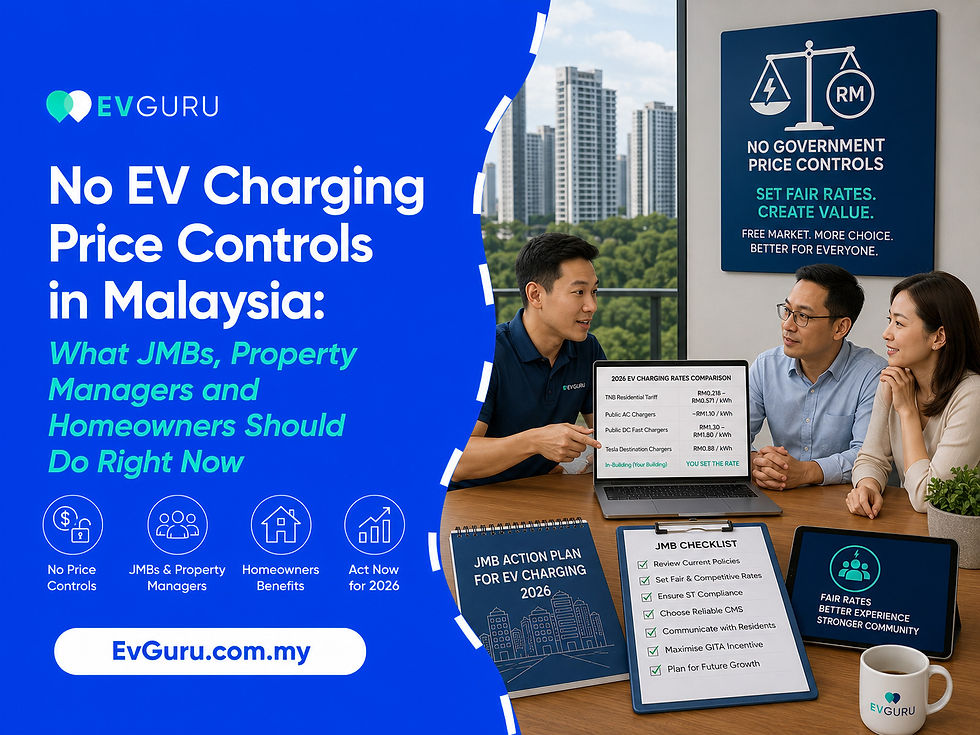
No EV Charging Price Controls in Malaysia: What JMBs, Property Managers and Homeowners Should Do Right Now

Malaysia will not cap public EV charging prices. According to Bernama, the Ministry of Investment, Trade and Industry (MITI) confirmed in late July 2026 that charging rates are set entirely by Charge Point Operators (CPOs) based on their own commercial considerations — with no government price-control mechanism in place. For anyone planning to rely on public chargers as a primary energy source, this is a material cost risk. For JMBs, property managers, and CPO investors evaluating operator contracts, the implications are even more direct.
The practical answer is straightforward: own your charging infrastructure wherever possible, whether at home or on your property. Private wallbox charging at TNB residential tariff rates remains the most cost-stable option available to Malaysian EV owners in 2026. The rest of this article explains why — and what to negotiate if you cannot avoid a CPO contract.
The 60-Second Answer: Own Your Charger, Own Your Rate
Public EV charging in Malaysia is a free market. There is no price floor, no price ceiling, and no regulatory body that will intervene if a CPO raises its rates. MITI has confirmed this is deliberate policy to attract private investment and expand the charging network. The government's collaboration with the Energy Commission (Suruhanjaya Tenaga / ST) and TNB covers safety and technical standards — not what you pay per kWh.
If you are a homeowner with a landed property or a condo bay, the cleanest hedge against CPO price volatility is a dedicated home wallbox charger running on your own TNB meter. If you are a JMB or property manager, deploying your own managed charging infrastructure — rather than signing over control to a third-party CPO — keeps rate-setting authority inside your building.
What Unregulated Rates Actually Look Like Today
The spread between home charging and public fast-charging is already significant. The table below illustrates current market rates as of mid-2026, based on publicly reported figures from multiple industry sources.
Charging Method | Approx. Rate (RM/kWh) | Who Controls the Price |
TNB residential tariff (home, lowest tier) | ~RM0.21 | Government-regulated |
TNB residential tariff (home, mid-tier) | ~RM0.45–0.55 | Government-regulated |
Public AC charger (mall/hotel) | RM0.90–RM1.15 | CPO — unregulated |
Public DC fast charger (30–180 kW) | RM1.20–RM1.80 | CPO — unregulated |
Highway DC fast charger (BESS-backed sites) | Up to RM1.80+ | CPO — unregulated |
Tesla Supercharger (non-member) | RM1.80 + congestion fee | CPO — unregulated |
The gap is stark. According to industry data, a full charge on a 60 kWh EV at home costs roughly RM13–RM34 depending on your TNB tariff tier. Relying on public DC fast chargers for the same top-up can cost RM72–RM108 at current rates — before any future price increases. And because pricing is unregulated, those increases require no government approval.
MITI has stated it will continue working with ST and TNB to monitor market conditions and ensure fees remain "fair and competitive" — but monitoring is not the same as capping. There is no enforcement mechanism attached to that commitment.
Pricing Risk by Reader Type: Homeowners vs. JMBs vs. CPO Investors
Reader Type | Key Risk | Best Mitigation |
Landed homeowner | Over-reliance on public chargers if no home charger installed | Install a 7.4–22 kW wallbox; lock in TNB tariff rates |
Condo resident (own bay) | Dependent on JMB or CPO rate decisions you cannot control | Apply for private bay charger approval; use your own sub-meter |
JMB / property manager | Signing long-term CPO revenue-share contracts without rate control clauses | Own the hardware; retain rate-setting authority via CMS dashboard |
CPO investor / commercial developer | Margin squeeze if electricity cost rises but contract fixes end-user rates | Build dynamic pricing and rate-review clauses into all operator agreements |
For Homeowners: Why Your Wallbox Is Your Price Lock
TNB's residential electricity tariff is set by the government and changes infrequently. A home EV charger installation — starting from RM1,590 for single-phase and RM1,650 for three-phase — effectively lets you convert your car's fuel cost to a government-regulated utility rate for the life of the vehicle.
For YA 2026, homeowners who purchase and install a qualifying EV charger can claim up to RM2,500 in personal income tax relief, covering wallbox cost, installation labour, and wiring. That incentive reduces your effective payback period significantly.
Landed home: straightforward installation from RM1,590 (single-phase), no JMB approval needed — see the full landed home installation guide
Condo with private bay: requires written JMB or MC approval before any work; the ST EVCS guideline (GP/ST/No. 54/2025) mandates a Type B RCD and prohibits Mode 1 charging
All installations must be carried out by a Suruhanjaya Tenaga-registered licensed Wireman — never an unlicensed contractor
RM2,500 personal income tax relief claimable for YA 2026 — apply to wallbox purchase, installation labour, and associated wiring costs
EVGuru's Guru Swift Advance smart wallbox (7.4 kW–22 kW) supports app-based scheduling, load management, and IP66 tropical-rated housing
For JMBs and Property Managers: Evaluating CPO Contracts in an Unregulated Market
An unregulated market creates a specific risk for JMBs that sign revenue-sharing agreements with CPOs: the operator controls the rate charged to your residents, not you. If the CPO raises its per-kWh price, residents complain to your committee — even though your committee signed away pricing authority. Understanding what to negotiate upfront is critical.
Contract Clause | Why It Matters | What to Push For |
Rate-setting authority | Who decides what residents pay per kWh | JMB retains the right to set or approve end-user rates via the CMS dashboard |
Rate-review frequency | How often the CPO can change pricing | Annual cap on rate increases, tied to TNB tariff movements |
Hardware ownership | Who owns the charger if the contract ends | JMB owns the hardware from Day 1; CPO provides software only |
Exit clause | Minimum contract term and penalty for early exit | Maximum 3-year initial term, 90-day written exit notice |
Revenue transparency | How electricity cost vs. revenue is reported | Real-time CMS dashboard with monthly billing statements |
The alternative to a CPO revenue-share arrangement is to own and operate the charging infrastructure directly. EVGuru's managed charging systems for condos and commercial properties give property management a CMS dashboard where they set the per-kWh rate, view real-time revenue and consumption, and configure idling fees — all without sharing margin with a third-party operator.
Communal multi-bay systems are scoped and priced per project; request a site assessment to begin.
There is also a time-sensitive tax angle for commercial decision-makers. Per MIDA, CPOs and commercial property operators investing in EV charging infrastructure may qualify for the Green Investment Tax Allowance (GITA), which provides a 100% investment tax allowance on qualifying capital expenditure, offsettable against up to 100% of statutory income per assessment year. The current GITA window expires 31 December 2026. Lead time for site assessment, installation, and MGTC application is typically 4–8 weeks — meaning the window to act within the confirmed incentive period is narrow.
The one mistake to avoid: Approving CPO or resident EV charger requests on an ad-hoc, bay-by-bay basis without a building-wide EV charging policy. Ad-hoc installations on uncoordinated circuits risk overloading the main distribution board (MDB), create compliance grey zones under ST EVCS guidelines, and leave your JMB exposed to escalating CPO rates with no structural remedy. A single coordinated infrastructure plan — with a dedicated Electric Vehicle Distribution Board (EVDB), dynamic load balancing, and sub-metering — is safer, cheaper per bay at scale, and positions your building ahead of future demand. Visit the condo and apartment EV charging page to see how a full-building rollout is structured.
2026 Incentive Deadlines at a Glance
Incentive | Who Qualifies | Amount | Deadline |
Personal income tax relief | Homeowners purchasing & installing a qualifying charger | Up to RM2,500 | Claimable for YA 2026 |
GITA (Green Investment Tax Allowance) | Commercial entities, CPOs, property operators | 100% investment tax allowance on qualifying capex | 31 December 2026 |
Import duty exemption on EV chargers | All buyers | 0% import duty | Extended to 2027 |

FAQ
Will Malaysia ever regulate EV charging prices?
As of August 2026, the answer is: not anytime soon. MITI confirmed to the Dewan Negara that Malaysia's policy is to allow CPOs to set their own rates in order to encourage private investment and network expansion. MITI and ST are collaborating on a future regulatory approach, but no price-control mechanism has been introduced, and no timeline for one has been announced. Plan your charging strategy on the assumption that public rates will remain market-determined.
How much cheaper is home charging vs public charging in Malaysia?
Significantly cheaper. TNB residential tariff rates start at approximately RM0.21/kWh for low-usage households. Public AC chargers at malls run RM0.90–RM1.15/kWh, while highway DC fast chargers reach RM1.60–RM1.80/kWh. For a 60 kWh EV, a full home charge costs roughly RM13–RM34 depending on your tariff tier, versus RM72–RM108 at public DC rates. Home charging is the most cost-stable option in an unregulated public market.
Can my JMB set its own EV charging rate for residents?
Yes — if your JMB owns the charging hardware and operates via its own Charge Management System (CMS). In that setup, property management can set the per-kWh rate, earn the margin between the TNB electricity cost and the resident rate, and adjust pricing at the committee's discretion. If you instead sign a revenue-share agreement with a third-party CPO, rate-setting authority typically passes to the operator. Negotiating to retain rate control as a contract clause is strongly advisable in the current unregulated environment.
Does GITA apply to condo JMBs installing EV chargers?
GITA applies to companies — Malaysian-incorporated Sdn Bhd or Bhd entities. If your JMB or property management company is structured as a qualifying entity and is investing in EV charging infrastructure as a commercial green technology asset, it may be eligible for the 100% investment tax allowance under GITA. The current window closes 31 December 2026, and MGTC pre-approval is required before the project begins. Speak to your tax advisor and contact EVGuru for a commercial project scoping call — lead times for assessment and installation mean acting now is essential.
What EV charger should I buy for my home in Malaysia in 2026?
For most landed homes with a standard 60A single-phase supply, a 7.4 kW smart wallbox is the right fit — it charges most EVs overnight and is compatible with all Type 2 vehicles sold in Malaysia. If you have a three-phase supply or want faster top-up speeds, a 22 kW unit maximises your connection. EVGuru's Guru Swift Advance covers both configurations (7.4 kW–22 kW), is IP66-rated for Malaysia's tropical climate, and comes with a 2-year warranty when purchased from EVGuru and installed by EVGuru's licensed team. Browse the full range at the EV charger hub.
Sources & Assumptions
MITI statement on unregulated EV charging rates: reported by Bernama, published in Malay Mail, 29 July 2026
Public charger count (6,416 as of 31 May 2026): multiple industry sources citing Energy Commission / Suruhanjaya Tenaga data
Public charging rate ranges (AC RM0.90–RM1.15/kWh; DC RM1.20–RM1.80/kWh): aggregated from multiple publicly reported CPO pricing disclosures as of mid-2026; rates are operator-set and subject to change without notice
TNB residential tariff range (RM0.21–RM0.57/kWh): TNB gazetted residential tariff schedule; actual household rate depends on total monthly consumption tier
Home charging cost estimate (RM13–RM34 for a 60 kWh battery): assumes standard TNB tiered tariff, excludes charger losses; stated as approximate
GITA (100% investment tax allowance for EV charging infrastructure, CPOs): per MIDA official statement and MGTC Green Investment Tax Allowance guidelines; deadline 31 December 2026
Personal income tax relief (up to RM2,500 for EV charger purchase and installation): claimable for YA 2026, per MGTC/MIDA guidelines and official government incentive framework
ST EVCS guideline (GP/ST/No. 54/2025): Suruhanjaya Tenaga, issued February 2025; mandates Type B RCD for condo EV charger installations and prohibits Mode 1 charging
EVGuru installation pricing: single-phase from RM1,590; three-phase from RM1,650. All other EVGuru project pricing is quoted per project
2-year EVGuru warranty applies only when the charger is purchased from EVGuru AND installed by EVGuru's licensed team
Ready to lock in cost-certain EV charging — at home or across your property? EVGuru's licensed team covers Peninsular Malaysia end-to-end: site assessment, load calculation, ST-compliant installation, and ongoing support. Request your free site assessment and get a fixed, transparent quote — no CPO contract required.