No EV Charging Price Controls in Malaysia: What JMBs, Property Managers and Homeowners Should Do Right Now

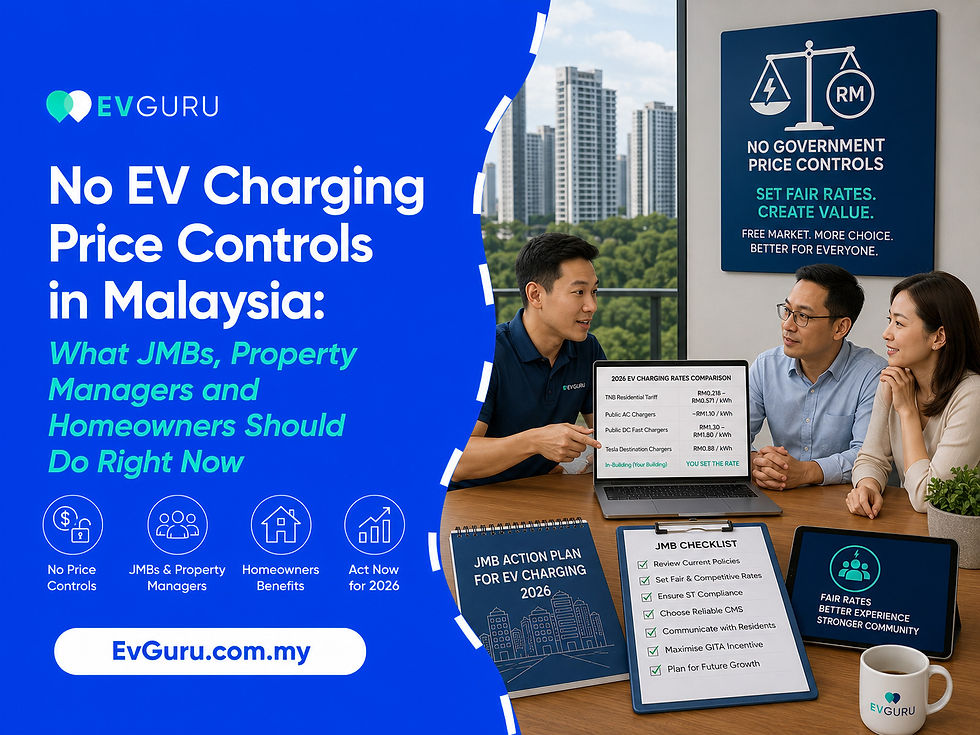
Malaysia's Ministry of Investment, Trade and Industry (MITI) confirmed to the Dewan Negara in July 2026 that the government has not introduced any price control mechanism for public EV charging services. Rates are set entirely by individual station operators based on their own commercial considerations. For JMB committees, property managers, and corporate decision-makers, this is the green light you have been waiting for — you can price your in-building chargers competitively, generate revenue, and still remain cheaper than public DC networks.
The 60-Second Answer: Free-Market Charging Is the Law of the Land
According to Bernama's reporting on MITI's Dewan Negara reply, charging station operators set their own rates with no government ceiling or floor. MITI's explicit reasoning is that a hands-off approach encourages private sector investment and competition, which in turn accelerates expansion of the national charging network. As of 31 May 2026, Malaysia had 6,416 public EV chargers installed nationwide — 96% of them in Peninsular Malaysia.
The policy does not mean the Wild West, however. MITI clarified that EV charging infrastructure must still comply with technical standards and safety requirements enforced by Suruhanjaya Tenaga (ST), MITI itself, and local authorities. MITI is also working with ST and TNB on developing a longer-term regulatory framework for charging fees — but that framework does not yet exist, which means 2026 is precisely the right time to move.
What Free-Market Pricing Means: Public Rates vs. What You Can Offer
Without a price ceiling, public charging network operators can — and do — charge a wide range of rates. Understanding where market rates currently sit lets you set a figure that attracts residents and tenants while still covering your electricity cost and generating a surplus.
Charging Scenario | Typical Rate (2026) | Who Controls the Price |
TNB residential tariff (home charging) | RM0.218–RM0.571 per kWh (progressive) | TNB tariff schedule |
Public AC chargers (third-party operators) | ~RM1.10 per kWh | Individual CPO |
Public DC fast chargers (50–180 kW) | RM1.30–RM1.80 per kWh | Individual CPO |
Tesla Destination Chargers (from 28 Jul 2026) | RM0.88 per kWh | Tesla Malaysia |
In-building AC charger — JMB / property manager set rate | Operator's commercial decision — no government ceiling | Your committee |
The gap between TNB's residential tariff (your actual electricity cost) and what public DC operators charge is substantial. A JMB that installs 22kW AC chargers and prices sessions at a modest RM0.70–0.80 per kWh is offering residents a compelling saving versus public DC, while still clearing a meaningful surplus above the TNB tariff cost. That surplus can offset maintenance fees, fund sinking funds, or simply reduce the building's overheads.
Implications for JMBs and Commercial Property Managers
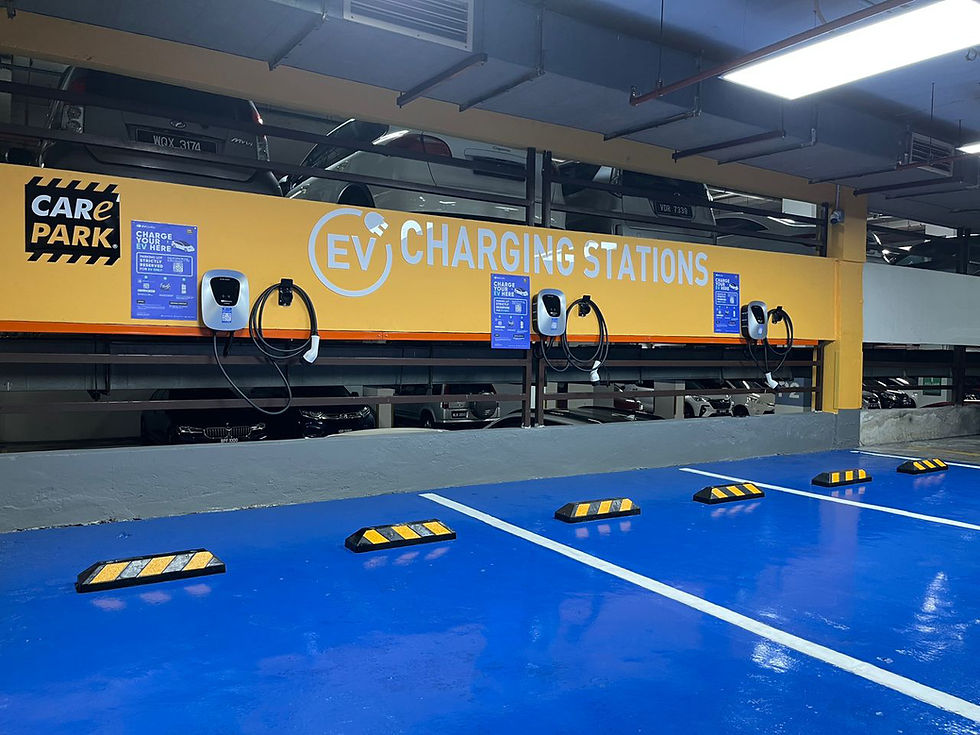
The absence of price control is not a risk — it is a commercial opportunity. Property management can set the charging rate per kWh and earn the margin between what residents pay and the actual electricity cost, with a charging management system (CMS) dashboard to monitor revenue, consumption, and usage patterns in real time.
Revenue without the ceiling: No government cap means you can set a rate that is attractive to residents yet profitable for the building — typically between the TNB residential tariff and the lowest public AC rate on the market.
Amenity value and property differentiation: EV charging is increasingly a tenant expectation. Buildings offering managed in-house charging at fair rates will attract and retain EV-owning residents as Malaysia's EV population grows.
GITA (Green Investment Tax Allowance) incentive — expires 31 Dec 2026: Commercial operators, JMBs, and developers who qualify can claim a 100% investment tax allowance on EV charging infrastructure capex for a period of five years, offsetable against up to 100% of statutory income. This deadline is hard — apply before 31 December 2026.
Compliance is non-negotiable, but straightforward: All installations must follow Suruhanjaya Tenaga guidelines (GP/ST/No. 54/2025), use ST-registered licensed Wiremen, include a Type B RCD, and be on dedicated circuits. EVGuru handles all of this as standard on every commercial project.
Lock in your terms now before a regulatory framework arrives: MITI has signalled it is developing a future regulatory approach for charging fees in collaboration with ST and TNB. Setting your in-building rate structure now, while the market is fully open, gives your building established commercial terms before any future framework potentially constrains them.
For condos, strata blocks, offices, and car parks ready to move forward, explore our commercial EV charging solutions and our dedicated condo and JMB charging page for specifics on JMB approval, metering, and billing system options. EVGuru has completed thousands of installations across Peninsular Malaysia and can present directly to your JMB committee.
How to Set a Competitive Charging Rate: A Practical Framework for JMBs
Rate-Setting Variable | Guidance |
Your electricity cost (TNB tariff) | RM0.218–RM0.571 per kWh depending on building's total consumption band |
Minimum viable rate | TNB tariff + ~RM0.10–0.20 to cover wiring amortisation and CMS fees |
Competitive sweet spot | RM0.60–0.80 per kWh — visibly cheaper than public AC/DC networks |
Premium justified rate | Up to RM1.00 per kWh if chargers are 22kW, app-controlled, and roofed/covered bays |
Maximum practical ceiling (market benchmark) | Below RM1.10 per kWh (current typical public AC rate) to retain resident loyalty |
These figures are guidelines only, not EVGuru-set rates — your actual TNB supply tariff, cable run costs, and project-specific capex will determine the right number for your building. A site assessment is the only accurate starting point.
Implications for Homeowners (Landed and Condo Residents)
For landed homeowners, the absence of public charging price controls actually reinforces the case for a dedicated home wallbox. Public DC charging at RM1.30–1.80 per kWh is between two and eight times the cost of charging at home on TNB's residential tariff. Installing a home EV wallbox now locks in the cheapest possible per-kWh rate for the life of your vehicle.
Scenario | Charger Type | Approx. Cost per Full Charge (60 kWh battery)* | Price Control? |
Home — landed (TNB tariff, low band) | 7.4kW wallbox | ~RM13–RM22 | TNB tariff — stable |
Home — condo (JMB-managed rate) | 22kW AC shared charger | Varies by JMB rate — estimate RM36–RM48 | No government cap |
Public AC (third-party operator) | AC up to 22kW | ~RM66 | No government cap |
Public DC fast (third-party operator) | DC 50–180kW | RM78–RM108 | No government cap |
Tesla Destination (from 28 Jul 2026) | AC 11kW | ~RM53 | No government cap |
*Assumptions: 60 kWh usable capacity; TNB low-band rate RM0.218–0.365/kWh for home scenario; public rates per market data cited above. Actual costs vary by vehicle, SOC, and network operator.
Landed homeowners: Installation starts from RM1,590 (single-phase) or from RM1,650 (three-phase) — see the landed home installation guide for what's included. Personal income tax relief of RM2,500 is claimable for YA 2026 on the wallbox purchase and installation cost.
Condo residents: Push your JMB to install managed shared chargers — with no government rate ceiling, a well-run JMB has every incentive to do so. If your JMB needs persuading, EVGuru can present directly to the committee.
Type 1 vehicle owners: If your EV uses a Type 1 connector, you will need a Type 1 to Type 2 adapter to use Malaysian-standard wallboxes and public AC chargers. Browse the EVGuru charger hub — EVGuru is Malaysia's only direct seller of this adapter.
The one mistake to avoid: Assuming that because there is no price control today, there will never be one. MITI explicitly stated it is collaborating with ST and TNB on developing a regulatory framework for EV charging fees. JMBs and commercial operators who delay installing now risk having to retrofit their financial models around future rules — and missing the GITA 100% investment tax allowance that expires on 31 December 2026. Install, set your rate in the open market window, and recover your capex before the landscape changes.
Charger Options: Matching Hardware to Property Type
Property Type | Recommended Charger | Power Output | Suitable For |
Landed home — single phase | Guru Swift | 7.4kW | Overnight home charging |
Landed home — three phase | Guru Swift Advance | 7.4kW–22kW | Faster top-up, future-proofed |
Condo private bay | Guru Swift Advance (smart, app-controlled) | 7.4kW–22kW | Sub-metered private use |
Condo shared / JMB-managed | Guru Swift Advance with CMS | 7.4kW–22kW | Revenue metering, session billing, reporting |
Car park / commercial / DC fast charging | Quoted per project | 22kW AC or DC fast | High throughput, revenue model |
View the full Guru Swift Advance flagship for specs, IP66 weatherproof rating (important for Malaysia's tropical climate and open car parks), and smart load management features. All EVGuru chargers come with a 2-year warranty when both the charger purchase and installation are completed through EVGuru.

FAQ
Can my condo JMB charge residents whatever rate they want for EV charging in Malaysia?
Yes — as confirmed by MITI in its July 2026 Dewan Negara reply, there is no government price control mechanism for EV charging services in Malaysia. Rates are set by charging station operators based on their own commercial considerations. A JMB is a charging station operator within its own building, so it can set the per-kWh rate it charges residents. The practical constraint is market competitiveness: set rates too high and residents will complain; set them reasonably below public AC network rates and you create genuine resident value while generating building revenue.
Will the government ever regulate EV charging prices in Malaysia?
MITI has indicated it is working with Suruhanjaya Tenaga and TNB on developing a regulatory approach for EV charging fees, so some form of future framework is possible. However, no timeline or mechanism has been announced as of July 2026. The current policy stance is deliberately hands-off to attract private investment and expand the network. JMBs and commercial operators should treat 2026 as the open-market window and establish their charging infrastructure and rate structures now.
How much does it cost for a condo or commercial property to install EV chargers in Malaysia?
For a private single-bay condo installation, EVGuru starts from RM1,590 (single-phase) or from RM1,650 (three-phase) for the installation service — the charger cost and any cabling variations are additional and site-specific. Multi-bay shared setups, commercial car parks, and full JMB projects are quoted per project, as scope varies significantly by building age, electrical capacity, and distance from the distribution board. Obtain a free site-specific quote here.
Is there a tax incentive for businesses or JMBs installing EV chargers in Malaysia in 2026?
Yes. Qualifying commercial entities — including charging point operators — can apply for the Green Investment Tax Allowance (GITA), which offers a 100% investment tax allowance on qualifying EV charging infrastructure capex for a period of five years, offsetable against up to 100% of statutory income per assessment year. This incentive is confirmed until 31 December 2026. Applications for GITA Project (Business Purposes) go through MIDA. Act before the deadline — unused allowance carries forward, but new qualifying expenditure must be incurred before 31 December 2026. See our commercial EV charging page for more on how commercial projects are structured.
As a homeowner, why should I install a home wallbox if public charging has no price ceiling?
Precisely because public charging has no ceiling. Public DC fast chargers currently run at RM1.30–1.80 per kWh. Your home TNB tariff starts at RM0.218 per kWh for low-consumption households. Over a year of driving, that difference adds up to thousands of ringgit. A home wallbox installation — starting from RM1,590 for single-phase — pays for itself in fuel savings within a manageable timeframe, and you also qualify for a RM2,500 personal income tax relief claimable for YA 2026. Explore home wallbox options or read the full landed home installation guide.
Sources & Assumptions
MITI Dewan Negara written reply, July 2026 — confirmed no price control on public EV charging; rates set by operators; 6,416 public chargers nationwide as of 31 May 2026 (96% Peninsular Malaysia). Reported by Bernama, The Sun, and Malay Mail.
Suruhanjaya Tenaga (ST) guidelines GP/ST/No. 54/2025 — mandatory compliance for all EV charger installations in Malaysia; requires licensed Wiremen, dedicated circuits, Type B RCD.
TNB residential tariff structure — progressive rate from RM0.218/kWh (≤200 kWh/month) to RM0.571/kWh (>900 kWh/month); source: publicly available TNB tariff schedule.
Public charging market rates (2026) — AC ~RM1.10/kWh, DC RM1.30–RM1.80/kWh; Tesla Destination Chargers RM0.88/kWh from 28 July 2026. Per market data from The Rakyat Post and industry sources.
GITA (Green Investment Tax Allowance) — 100% investment tax allowance on qualifying EV charging capex, offsetable against 100% statutory income, confirmed to 31 December 2026. Per MIDA and MITI statements.
Personal income tax relief — RM2,500 per individual for EV charger purchase, installation, and subscription fees; claimable for YA 2026. Per MIDA official communications.
EVGuru pricing — installation from RM1,590 (single-phase) and from RM1,650 (three-phase). Commercial and multi-bay projects: quoted per project. 2-year warranty applies when charger purchase AND installation are both through EVGuru.
Charging cost table assumptions — 60 kWh usable battery capacity used as reference; actual costs vary by vehicle model, state of charge at session start, and network operator.
Whether you manage a 500-unit condo block or just bought your first EV for your terrace house in Subang, the 2026 free-market window for EV charging is open right now — and EVGuru can help you maximise it. Request a free site assessment and installation quote and our team will give you a clear, no-obligation breakdown tailored to your property.