EV Charging Solutions for High-Rise Living in Penang

Updated: Aug 11
The 60-Second Answer: Plan for 5–15% of Total Bays, Not Just the 2% Minimum
Penang's planning guideline requires new developments to allocate at least 2% of parking bays as EV charging-ready spaces. That is a regulatory floor, not a forward-looking target. EV registrations in Malaysia have grown over 100% year-on-year into 2026 while charging infrastructure has been built at a significantly slower pace, per analysis published by Penang Property Talk. A development with 300 parking bays that complies with the 2% rule has just 6 charging bays — almost certainly inadequate within three to five years.
The practical recommendation for JMBs planning or retrofitting today: target 5% at minimum for existing buildings, 10–15% for new builds or full retrofits. For a 200-unit condo, that means 10–30 bays — a range that aligns with what Penang's most forward-looking developers are now delivering.
Charging Bay Ratios: How to Size Your Infrastructure by Property Type
Property Type | Minimum Regulatory Requirement | Recommended 2026 Target | Planning Horizon |
New high-rise development (Penang) | 2% of total parking bays | 10–15% of total parking bays | Ready for 2028–2030 demand |
Existing condo / service apartment | None (retrofit) | 5–10% of total parking bays | Phase in over 2–3 years |
Gated community / serviced residence | None (retrofit) | 5–10%, prioritise covered bays | Phase in over 2–3 years |
Commercial office car park | Align with local authority guidelines | 10–20% to meet tenant ESG demands | Budget in annual capex cycle |
Mixed-use development | 2% (residential component) | 10–15% combined residential + commercial | Integrate at D&B stage |
Incorporating EV charging facilities during the design and construction stage is not only more cost-effective than retrofitting later, but also helps future-proof developments against evolving homeowner expectations — a point raised directly in coverage of the M Amaya project. For existing buildings, the key question is whether your main distribution board (MDB) has headroom for the additional load. This is the first thing an ST-registered Competent Person will assess.
TNB Approval and ST Compliance: The Step-by-Step Process for JMBs
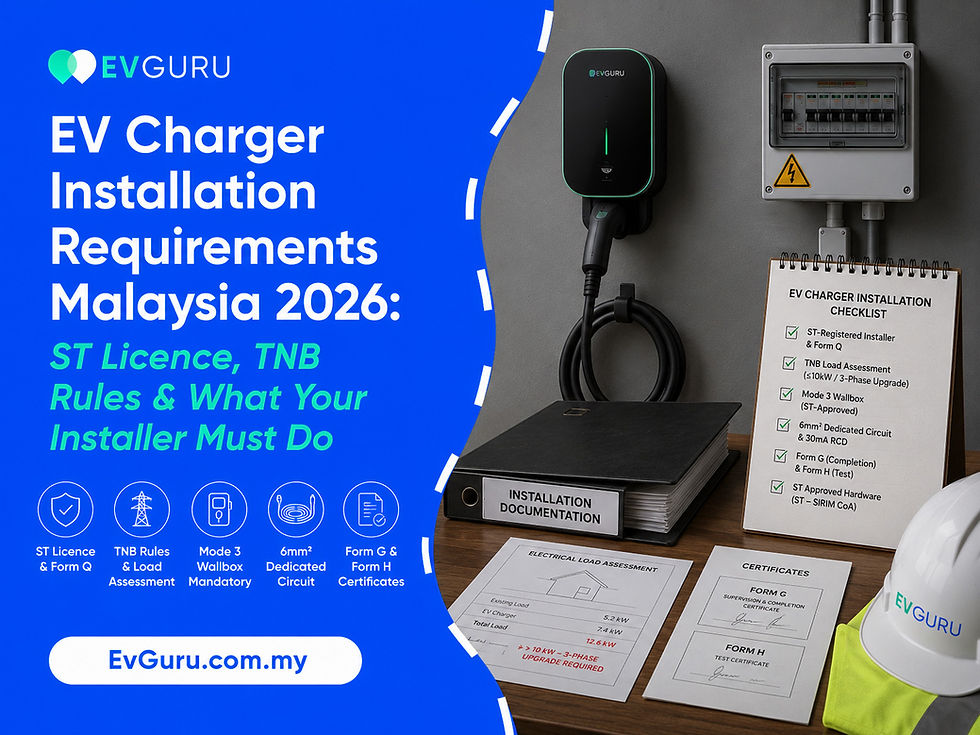
All EV charger installations in Malaysia fall under Suruhanjaya Tenaga (ST) guidelines — specifically GP/ST/No. 54/2025 — and must be carried out by an ST-registered Competent Person. For a communal installation serving multiple bays, the process is more involved than a single private bay setup.
JMB/MC resolution: Shared community chargers require a formal management committee decision — not just verbal agreement. Put it to an AGM or EGM and minute it properly.
Load assessment by a Competent Person: An ST-certified electrician assesses whether the building's existing TNB supply and MDB can handle the additional EV load. If the building needs a supply upgrade, TNB must be notified and a formal load upgrade application submitted.
Metering strategy: JMBs must decide between individual sub-metering per bay (each resident billed directly) or a shared metering model where the JMB charges residents per kWh via a Charge Management System (CMS). Both are valid; the CMS route allows the JMB to set a margin above the TNB tariff to offset maintenance costs.
RCD Type B installation: Under current ST guidelines, all condo EV charger installations require a Type B Residual Current Device (RCD) to prevent DC fault currents from feeding back into the building's AC grid. This is non-negotiable and should be included as standard in every bay.
ST submission and sign-off: Upon completion, the Competent Person submits the electrical installation certificate to ST. Work cannot be energized without this clearance.
Charge Management System (CMS) setup: For multi-bay communal installations, a cloud-based CMS enables booking, billing, usage monitoring, and remote management — essential for any installation beyond a handful of bays.
EVGuru handles the full process end-to-end for JMBs and MCs — including presenting the charging proposal to your committee and drafting the relevant documentation. See our condo and apartment EV charging page for how this works in practice.
Cost-Sharing Models: Which Funding Structure Works for Your Building?
The JMB-owned shared charger model is increasingly popular because property management can set the charging rate per kWh and earn the difference between what residents pay and the actual TNB electricity cost. Many condos use this approach to offset maintenance costs or fund new amenities. With a CMS dashboard, JMBs can view total revenue, electricity consumption, and usage patterns in real-time.
The one mistake to avoid: Approving a fixed number of chargers — say, 6 bays to satisfy the 2% rule — without also installing the conduit, cable tray, and DB sub-panel capacity to expand to 20 or 30 bays later. Future-proofing the electrical infrastructure backbone at the point of first installation costs a fraction of what a full retrofit will cost in five years. Always ask your installer to spec the trunking and DB capacity for your 10-year EV adoption projection, not just your Day-1 headcount.
Incentives That Expire: What JMBs and Homeowners Must Act On in 2026
Incentive | Who It Applies To | What You Get | Deadline |
Personal income tax relief — EV charger | Individual homeowners / condo residents | Up to RM2,500 relief on purchase, installation, rental or subscription fees (claimable for YA 2026) | Extended to YA 2027 per LHDN schedule |
GITA (Green Investment Tax Allowance) | Companies / commercial operators investing in EV charging | 100% investment tax allowance on qualifying capital expenditure over 5 years | Applications by 31 Dec 2026 |
Penang 2% EV-ready bay requirement | New property developments (Penang) | Regulatory compliance; minimum EV-ready bay allocation | Applies to all new submissions now |
For commercial operators and corporates, GITA is the most powerful lever available. Per MIDA, charging point operators who meet the criteria can receive 100% investment tax allowance over five years, which can be used to offset up to 100% of statutory income for each assessment year. Applications must be submitted before 31 December 2026 — there is no confirmed extension beyond that date. See our commercial EV charging solutions page for how to structure a qualifying project.
For individual condo residents, the RM2,500 personal income tax relief covers the cost of purchasing and installing a home EV charger, as well as subscription fees for EV charging equipment — and it is active for YA 2026. Keep your EVGuru installation invoice for your LHDN e-Filing submission.
What This Means for Homeowners in Penang High-Rises Right Now
If you own an EV and live in a Penang high-rise without a JMB-approved charging solution, you have two practical paths. First, apply to your JMB for a private charger at your own assigned bay — under the Strata Management Act 2013, your JMB or MC cannot unreasonably refuse a legitimate, compliant installation. Second, lobby your JMB to adopt the shared communal model, which removes the need for individual applications and benefits all current and future EV owners in the building.
Single-phase supply (most condos): Supports a 7.4kW wallbox — sufficient to fully replenish most EV batteries overnight. Installation starts from RM1,590.
Three-phase supply: Unlocks up to 22kW charging, halving overnight charge times for larger-battery EVs. Installation starts from RM1,650.
Charger selection: The Guru Swift Advance (7kW–22kW) supports both single and three-phase, has built-in CMS connectivity, and is rated IP66 for Malaysia's tropical humidity and rain exposure — important for open-deck car parks. A 2-year warranty applies when purchased from EVGuru and installed by EVGuru.
Browse all compatible home wallbox charger options or view our full EV charger range to compare specifications. If you drive a Type 1 vehicle, EVGuru is Malaysia's only seller of the Type 1 to Type 2 adapter — available via the charger hub.

FAQ
How many EV charging bays does a condo in Penang actually need?
Penang's planning guideline sets a minimum of 2% of total parking bays for new developments, but this is widely considered insufficient for real-world 2026 adoption rates. A practical planning target for new builds is 10–15% of total bays, with conduit and DB capacity sized for future expansion. For existing buildings retrofitting today, targeting 5–10% is achievable in phases and future-proofs against the rapid growth in EV ownership across Peninsular Malaysia.
Does our JMB need TNB approval before installing EV chargers in the condo car park?
Yes. Any communal EV charging installation requires an ST-registered Competent Person to conduct a load assessment and, if additional supply capacity is needed, submit a formal load upgrade application to TNB. All work must comply with ST guidelines GP/ST/No. 54/2025. The JMB must also pass a formal committee resolution approving the installation before any contractor begins work.
Can our JMB earn money from providing EV charging to residents?
Yes, this is one of the most compelling reasons for JMBs to take the initiative rather than waiting for individual resident requests. Under a JMB-owned shared charging model, the management can set a per-kWh rate above the TNB tariff cost, with the margin flowing into the building's maintenance fund. A Charge Management System handles automated billing, usage monitoring, and bay booking, removing administrative burden from the JMB committee.
What is GITA and how does it help our condo or office building claim back EV charger costs?
GITA — the Green Investment Tax Allowance — allows companies and commercial operators to claim a 100% investment tax allowance on qualifying EV charging capital expenditure over five years, which can offset up to 100% of statutory income per assessment year. This means a corporate building management company or car park operator can significantly reduce their net effective cost of a multi-bay installation. Applications must be submitted to MIDA by 31 December 2026. Individual residents cannot claim GITA; they use the separate personal income tax relief of up to RM2,500 per YA.
How much does it cost to install EV chargers in a condo car park in Malaysia?
For individual private-bay installations, EVGuru's pricing starts from RM1,590 (single-phase) or from RM1,650 (three-phase). For multi-bay communal projects — which involve shared trunking, a central sub-panel, metering, and CMS integration — the total project cost depends on the number of bays, cable run distances, the building's existing electrical infrastructure, and charger specifications. These projects are quoted per project after a site assessment. Request a site-specific quote here.
Sources & Assumptions
M Amaya / 20-bay benchmark: Reported by Newswav and Penang Property Talk, July 2026.
Penang 2% EV-ready bay guideline: Per Penang Property Talk coverage of the M Amaya development announcement.
EV registration growth (100%+ YoY into 2026): Per Penang Property Talk analysis, May 2026.
ST guidelines GP/ST/No. 54/2025: Referenced per Motorist.my and EVGuru.com.my published compliance guides.
GITA (100% ITA, applications by 31 Dec 2026): Per MIDA official statement reported by Bernama (Dec 2024) and MGTC GITA guidelines.
Personal income tax relief RM2,500 for YA 2026: Per LHDN schedule confirmed by money.com.my (verified Apr 2026) and L&Co Accountants YA 2026 relief list; extended to YA 2027 per Budget 2026.
Pricing assumption: EVGuru installation pricing from RM1,590 (single-phase) and from RM1,650 (three-phase) are the only stated EVGuru service prices. All multi-bay and commercial projects are quoted per project following a site assessment.
Warranty note: 2-year warranty applies only when charger is purchased from EVGuru and installed by EVGuru.
Whether you are a JMB committee planning a 20-bay rollout or an individual condo resident trying to get your first private charger approved, EVGuru's team covers the entire process — from load assessment and TNB coordination to ST-compliant installation and CMS onboarding. Request a free site assessment or visit our portfolio to see completed condo and commercial projects across Peninsular Malaysia.