Commercial EV Charger Uptime in Malaysia: What to Put in Your SLA

The short answer: For a Malaysian commercial site, ask for availability per connector during agreed service hours, then verify that drivers can authorise, start and receive power. A charger can show “online” while drivers still cannot charge. Before signing a service-level agreement (SLA), define when downtime begins, which exceptions apply, who owns each fault and what evidence closes a ticket. Track failed starts separately so recurring problems do not disappear inside a single uptime percentage.

Online is not the same as ready to charge
A charge point management system can show that a charger is communicating without proving that its connector, authorisation method or payment flow is working. Conversely, an interrupted dashboard connection is not always proof that a driver could not charge: that depends on the charger and its configured offline behaviour. Ask for both the device record and the driver outcome.
Measure | What to record | What it tells you |
Network online time | Time the charger communicates with its backend | Whether remote monitoring is working |
Connector availability | Time each advertised connector can deliver the agreed charging service | Whether a driver has a usable port |
Start success | Eligible attempts that begin delivering power, divided by eligible attempts | Whether faults recur despite high availability |
Restoration time | Time from recorded detection to a verified return to service | How long the fault actually affects drivers |
Define an eligible attempt before using the start-success figure. Decide how to count retries, incompatible vehicles and driver cancellations, and disclose excluded events. If one driver makes three retries, keep both the attempt count and the number of affected drivers where available. A working connector that is occupied is busy, not faulty; track blocked bays and queues separately.
What 98.75% can hide: a worked example
Assume four connectors, 16 advertised service hours per day and a 30-day month. One connector cannot start sessions for 24 service hours; the other three have no downtime. There are no exclusions, overlapping outages or changes to opening hours in this example.
View | Calculation | Result |
One connector’s service window | 16 × 30 | 480 hours |
Affected connector | (480 − 24) ÷ 480 | 95.00% available |
All four connectors combined | (1,920 − 24) ÷ 1,920 | 98.75% available |
At least one connector working | 480 ÷ 480 | 100%; hides the failed port |
Ask for the four connector rows alongside the fleet or site average. If the failing port is the only one accessible to a particular group of users, even the individual percentage can understate the impact. These figures are an example, not an EvGuru performance claim or a regulatory threshold.
What the operating agreement should spell out
Put this in writing | Specify before signing | Evidence to ask for |
Service window and denominator | Time zone, opening hours, connector IDs and treatment of partial outages | Monthly totals for each connector |
Clock start and exclusions | Use the first reliable detection or report; define utility outages and planned work separately | Dated event log and reasons for exclusions |
Response and restoration | Different deadlines for acknowledgement, remote diagnosis, site attendance and restoration | Timestamped tickets and named escalation owners |
Closure and recurring faults | Require an end-to-end test and escalation for repeated start failures | Test result, session ID and repeat-fault count |
A property manager can keep an internal view of all driver-facing downtime even if a contract excludes some events from service credits. That makes it possible to see the real disruption and still reconcile the supplier’s contract report. A support ticket marked “resolved” is not, by itself, evidence that the port can deliver power.
Run a driver test before accepting the site
Use an agreed acceptance script, with the operator and the property team present where practical. This is an operational handover checklist; electrical inspection, protective-device tests and maintenance belong with the competent contractor.
Label each connector consistently on the charger, in the app and in the incident log.
At each connector, use the payment or access method drivers will actually use. Confirm the session starts, delivers energy, stops and appears in the transaction report. Use an authorised test or refund process for payment checks.
Ask the operator to demonstrate alert routing and agreed offline behaviour under a controlled test. Record who is on call, who can gain site access and how signage is updated during an outage.
Ask for the asset list, maintenance schedule, inspection records and a monthly report sample. Suruhanjaya Tenaga’s EVCS guidelines set out maintenance schedules and recordkeeping in section 7.1. Confirm the requirements and licensing for your exact site and access model before opening it to drivers.
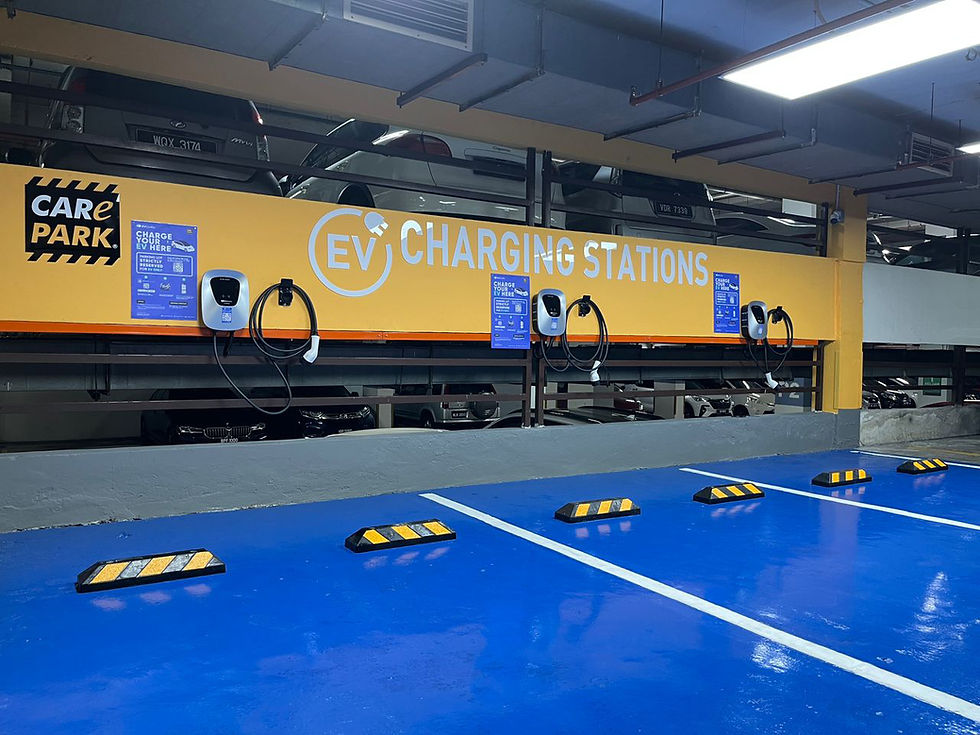
EvGuru project example: Hartamas Shopping Centre in Kuala Lumpur has three 22 kW public AC chargers, as documented in our commercial project portfolio. It illustrates why a host should ask for a record per connector. The project’s uptime is not stated here.
Compare EvGuru equipment and operating options
Option | Where it fits | What to confirm |
Controlled Type 2 AC bays where the built-in cable is useful | Confirm the exact variant, network integration, monitoring and billing requirements before ordering | |
Three-phase socketed AC pilot with a listed OCPP option | Test backend enrolment, authorisation and fault reporting on the selected configuration | |
Commercial sites that need reporting, billing and an operating partner | Put maintenance, parts, site attendance and reporting commitments in the proposal |
A charger spec sheet is useful for comparing hardware. Ask the operator to show one connector’s record from alert through verified restoration before you compare support offers.
Questions property teams ask
Is 99% uptime a legal minimum in Malaysia?
The 99% figure should not be assumed to be a Malaysian legal threshold. This guide uses illustrative contract metrics. Verify site-specific obligations with the applicable authority and agree any uptime target and its calculation with the operator.
Do software updates and utility outages count?
Write down how each is treated. If planned maintenance is excluded, specify the notice period and allowed window. Keep excluded events visible in the property’s own disruption report, even when they do not count against a contractual target.
What should we do if the app says available but charging fails?
Record the connector ID, time, access method and what the driver saw. If authorised staff can reproduce it with a compatible vehicle, add the test result and session record. Pass this to the operator; leave electrical troubleshooting to the appointed professionals.
What should the property manager send for a proposal?
Share the site type, operating hours, who will charge, the current equipment if any, who has access outside office hours and your preferred reporting. If you already have chargers, include a sample failure or support report.